Year: 2022

  • Moran et al., 2022, Nature Microbiology

    Microbial Metabolites in the Marine Carbon Cycle

    M. A. Moran, E. B. Kujawinski, W. F. Schroer, S. A. Amin, N. R. Bates, E. M. Bertrand, R. Braakman, C. T. Brown, M. W. Covert, S. C. Doney, S. T. Dyhrman, A. S. Edison, A. M. Eren, N. M. Levine, L. Li, A. C. Ross, M. A. Saito, A. E. Santoro, D. Segré, A. Shade, M. B. Sullivan, A. Vardi

    Figure 2 titled: Sources of the labile microbial metabolites in the surface ocean.

    One-quarter of photosynthesis-derived carbon on Earth rapidly cycles through a set of short-lived seawater metabolites that is generated from the activities of marine phytoplankton, bacteria, grazers, and viruses. Here, we discuss the sources of microbial metabolites in the surface ocean, their roles in ecology and biogeochemistry, and approaches that can be used to analyse them from chemistry, biology, modelling and data science. Although microbial-derived metabolites account for only a minor fraction of the total reservoir of marine dissolved organic carbon (DOC), their flux and fate underpins the central role of the ocean in sustaining life on Earth. 
    A picture of the list of contributing authors and departments.
  • Moran et al., 2022, Limnology and Oceanography

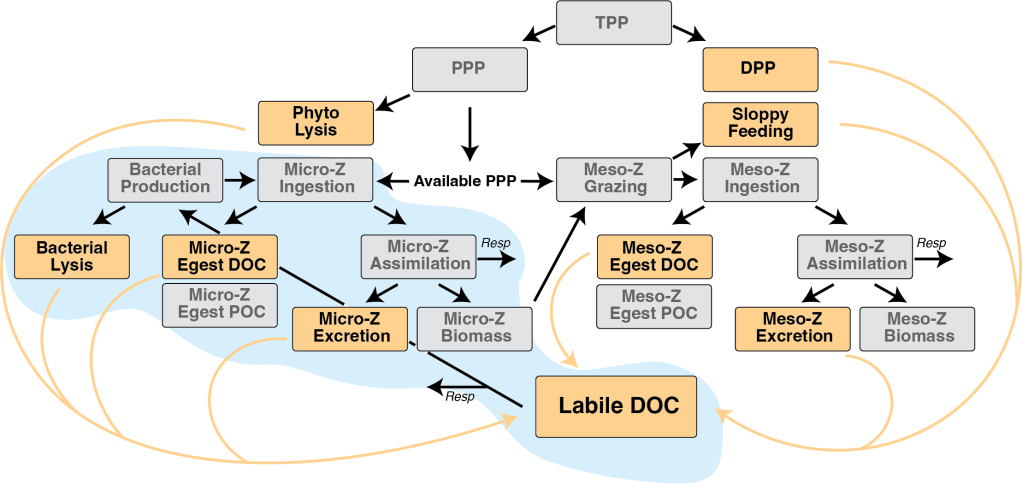
    The Ocean’s Labile DOC Supply Chain

    M. A. Moran, F. X. Ferrer-González, H. Fu, B. Nowinski, M. Olofsson, M. A. Powers, J. E. Schreier, W. F. Schroer, C. B. Smith, and M. Uchimiya

    Microbes of the surface ocean release, consume, and exchange labile metabolites at time scales of minutes to days. The details of this important step in the global carbon cycle remain poorly resolved, largely due to the methodological challenges of studying a diverse pool of metabolites that are produced and consumed nearly simultaneously. In this perspective, a new compilation of published data builds on previous studies to obtain an updated estimate of the fraction of marine net primary production that passes through the labile dissolved organic carbon (DOC) pool. In agreement with previous studies, our data mining and modeling approaches hypothesize that about half of ocean net primary production is processed through the labile DOC pool. The fractional contributions from three major sources are estimated at 0.4 for living phytoplankton, 0.4 for dead and dying phytoplankton, and 0.2 for heterotrophic microbes and mesoplankton.

    Box and arrow diagram showing the structure of the stocks and fluxes in the Sum-of-Sources model. Colored boxes and arrows represent labile dissolved organic carbon (DOC) components

  • Olofsson et al., 2022, ISME Communications

    Growth-Stage Related Shifts in Diatom Endometabolome Composition Set the Stage for Bacterial Heterotrophy

    M. Olofsson, F. X. Ferrer-González, M. Uchimiya, J. E. Schreier, N. R. Holderman, C. B. Smith, A. S. Edison, M. A. Moran

    Phytoplankton-derived metabolites fuel a large fraction of heterotrophic bacterial production in the global ocean, yet methodological challenges have limited our understanding of the organic molecules transferred between these microbial groups. In an experimental bloom study consisting of three heterotrophic marine bacteria growing together with the diatom Thalassiosira pseudonana, we concurrently measured diatom endometabolites (i.e., potential exometabolite supply) by nuclear magnetic resonance (NMR) spectroscopy and bacterial gene expression (i.e., potential exometabolite uptake) by metatranscriptomic sequencing. Twenty-two diatom endometabolites were annotated, with nine increasing in internal concentration in the late stage of the bloom, eight decreasing, and five showing no variation through the bloom progression. Some metabolite changes could be linked to shifts in diatom gene expression, as well as to shifts in bacterial community composition and their expression of substrate uptake and catabolism genes. Yet an overall low match indicated that endometabolome concentration was not a good predictor of exometabolite availability, and that complex physiological and ecological interactions underlie metabolite exchange. Six diatom endometabolites accumulated to higher concentrations in the bacterial co-cultures compared to axenic cultures, suggesting a bacterial influence on rates of synthesis or release of glutamate, arginine, leucine, 2,3-dihydroxypropane-1-sulfonate, glucose, and glycerol-3-phosphate. Better understanding of phytoplankton metabolite production, release, and transfer to assembled bacterial communities is key to untangling this nearly invisible yet pivotal step in ocean carbon cycling.

    Row A from figure 2. Endometabolites with significantly higher concentration in day 15 co-cultures compared to day 3 co-cultures.